Our vision
To transform Jindal Polyweaves private limited into a public limited company by the year 2029 and to celebrate company's annual function in Singapore by the same year.
Who we are
In 1993, a young yarn agent named Sushil Jindal left Haryana for Surat. He had been watching the city from a distance and could see it was about to become the centre of India's polyester trade. He arrived with no mill, no brand, and no plan beyond the next order. What he had was the willingness to move.
Three decades later, Jindal is a six-vertical group with 400+ machines, 500 workers, and ₹130 crore in annual turnover. Between then and now, every few years has asked the company to take another first step — into manufacturing, into weaving, into films, into digital printing, into diamonds, into lifestyle. Each one was taken before the conditions were ideal. That has been the discipline of the company since its first day. This is the story of those steps.
Our vision
To transform Jindal Polyweaves private limited into a public limited company by the year 2029 and to celebrate company's annual function in Singapore by the same year.
Our mission
We work as a team to supply quality products and to provide best customer service.
Our values
What we believe
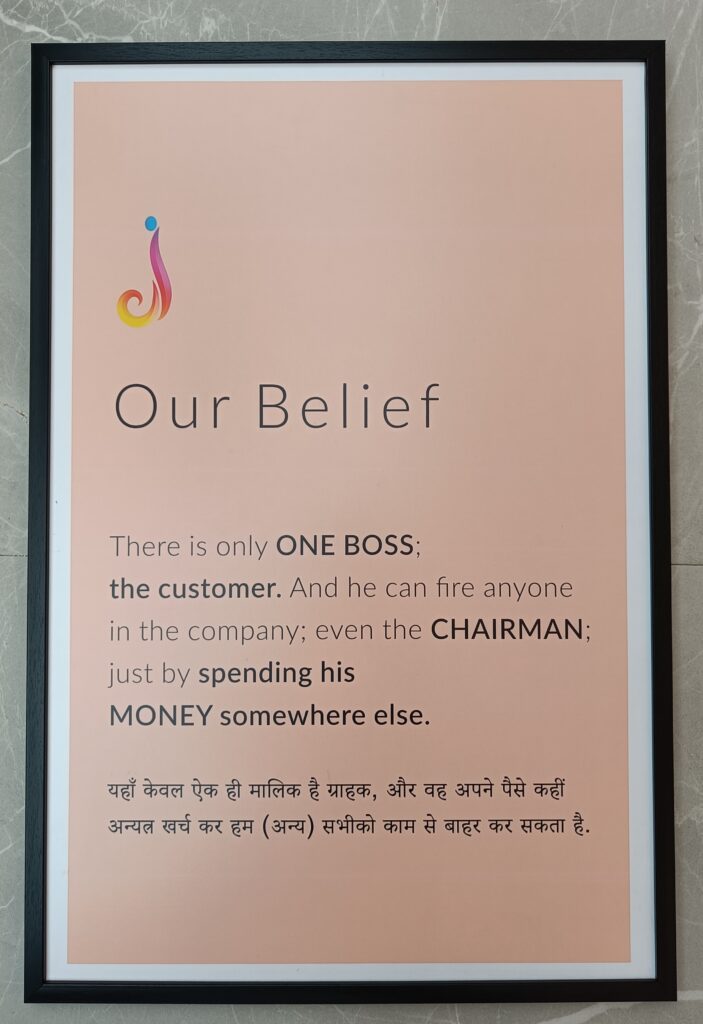
“There is only one boss — the customer. And he can fire anyone in the company, even the chairman, by spending his money somewhere else.”
A line we live by. Sam Walton wrote it; we’ve made it ours.
Sushil Jindal runs the business by a framework borrowed from the Bhagavad Gita. To rise, old systems must be allowed to fall. To keep building, we have to be willing to take things apart. Every upgrade we have made — from texturising in 2003 to digital printing in 2018 to lab-grown diamonds in 2021 — has required dismantling something that was working well enough, to make room for something that would work better. We do not protect what is. We protect what could be.
Every working day at Jindal begins the same way. A morning prayer. Then a gathering, in which each member of the team — from the floor up to the leadership — shares one thing they are grateful for. It takes ten minutes. It sets the temperature of the day.
In a family-run business, disagreements are not avoided. They are how good decisions get made. Anyone at Jindal can argue. Anyone can push back. But every business has an appointed decision-maker — for Jindal Polyweaves, Sushil Jindal; for Ivana By Jindal, Yogit Jindal — and once the debate has been heard, the final call is theirs. If the call is right, the credit is theirs alone. If it is wrong, everyone in the room takes responsibility. There is no blame. We learn together, and we move forward together.
People sometimes ask Sushil Jindal whether, looking back on three decades, there is any advice he would give his younger self. His answer is: no. It isn’t bravado — it’s a worldview. He believes that hard work and good intentions will, eventually, succeed. Temporary failures are temporary. Permanent things are built one decade at a time. He is grateful, above all, that his parents are here to see what he and his brother have built.